the cullinan diamond
Imagine 3,106 carats all in one diamond.
During an ordinary working day, on the 26th of January 1905, inside one of South Africa’s most productive mines, the Premier Mine near Pretoria, supervisor Captain Wells saw a flash of light reflected by the sun. Exposing from a rock, was what looked like a huge piece of glass. Wells took out his pocket knife and retrieved what is yet to be known as the largest diamond in the world. The Cullinan.

Left: Joseph Asscher makes the first cut into the Cullinan. Right: a replica.
It was named after the owner of the mine, sir Thomas Cullinan. After debating and voting as to whether it should be presented to King Edward VII of England as a gift, the gem was finally received and owned by his majesty. “For myself and my successors, this great and unique diamond will be kept and preserved among the historic jewels which form the heirlooms of the crown”.
Due to its immense value, transporting the diamond to England was a major issue. Faking a trip, detectives from London were placed into a boat that was supposedly caring the gem, while the real Cullinan finally got sent in an ordinary box through the post office!
At approximately 600 grams, 10cm wide and 7cm high the white diamond was twice the size of any other diamond previously discovered. This famous stone would later be cut by the I J Asscher brothers into 9 major pieces.

Left: The Cullinan V into a brooch. Right: Cullinan III and IV into a brooch
At the time, cutting technology had not yet evolved as much. Nothing could guarantee that this most valuable diamond would be processed correctly. Joseph Asscher was the most renowned cleaverer of the time. A special knife was made for him in order to divide the gem. Legend says, he fainted while performing a one-off move that broke the Cullinan in one blow, also.. breaking the knife. Another story goes that The first blow broke the knife and the diamond remained intact. A second attempt split it in two.
The 530,4 carat Cullinan I,also called The Great Star of Africa, and the 317,4 carat Cullinan II, the Second Star of Africa will be set in the Royal Scepter and the Imperial state Crown. Both gems are in the Crown Jewels of the United Kingdom. The other seven were all mounted in brooches, a ring and a necklace and have been worn by members of the royal family on state occasions.
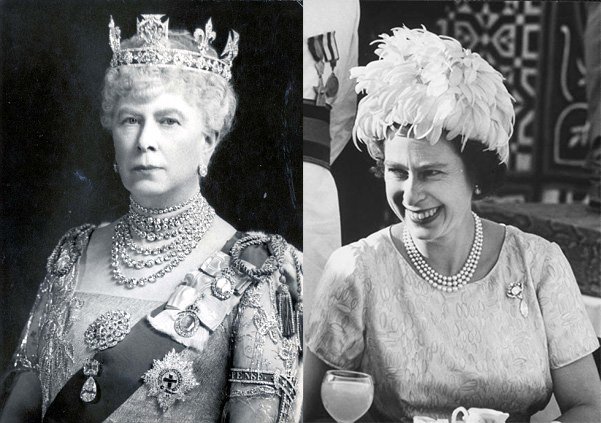
Queen Mary and Queen Elizabeth wearing a Cullinan brooch.
As the largest rough diamond the Cullinan’s value should really remain priceless,
some specialists give the gem a value of over 2$ billion…